Life, Peace & Justice Within
Promoting Catholic Social Teaching
God's Peace Within and Justice Around Me
Interested in Life, Peace and Justice Ministry? Share your thoughts and interests at
Our Survey link here.
Our Parish Life,
Peace & Justice
Ministry welcomes you to join any or all meetings that you are able to attend. (734-821-2121).
Community Support and Needs Assessment Form
Please complete
Our Community Support and Needs Assessment Form Survey linked hered....
https://forms.gle/5NSJCQcw4FfTVZ787
Looking for ways to live your faith beyond Sunday? The Peace & Justice Ministry explores how Catholic Social Teaching calls us to build peace, support human dignity, care for creation, and strengthen our community through education, advocacy, prayer, and action. Come join us — everyone has a place at the table.
Peace & Justice Ministry
for the Dignity of All Life
Our Saint Francis of Assisi Parish - Peace & Justice Ministry
promotes
Catholic Social Teaching
in our church, community and the world,
addressing threats to human dignity
through
education, advocacy and building community.
Come join us
_~_~_~_~_~_~_
as we together advance the strategic vision and plan!
~~ ~~ ~~
All are welcome.
~~~ ~~~ ~~~
- EDUCATING: Learning together and growing in faith and action.
- ADVOCATING: Speaking up for justice and standing beside those in need.
- CONNECTING: Building relationships and partnering for the common good.
Together, we live our faith and build a more just, compassionate world. Living the Catechism of the Catholic Church (CCC 2419-2449)
~~~ ~~~ ~~~
Our Parish
Peace & Justice
Ministry
welcomes you to join any or all meetings that you are able to attend. (734-821-2121).
Catholic Social Teaching - Major Themes
1. Life and dignity of the human person – All people are holy, made in the image of God.
2. Call to family, community and participation –
People are both holy and social; when one suffers, we all suffer.
3. Rights and responsibilities –
People have a basic right to life, food, shelter, health care, education and work.
4. Option for the poor and vulnerable –
The “Jesus” test of a community (of society) is how it treats its neediest members.
5. Dignity of work and the rights of workers –
Money, work and business exist to serve people, not the other way around.
6. Solidarity
– We want justice for all people.
7. Care for God’s creation –
The environment is God’s sacred creation.
Civilize It
Bring Christ's Peace into Election Season
You can help by participating in our next discussion
at St. Francis' Assisi Center.
- Tuesday, September 15th, Skills for Disagreeing Better.
SIGN-UP here!
Our Conversations/Workshop is facilitated by
Braver Angels Alliance of Washtenaw County.
This workshop
will
explore practical ways to engage in difficult conversations with civility, deepen our capacity to listen, and become faithful witnesses to the Gospel in our families, workplaces, parishes, and communities.
The St. Francis Parish - Life, Peace & Justice Ministry invites you to ...
In a season when elections and public issues can deepen divisions, followers of Christ are called to be witnesses of hope, charity, and truth. Jesus teaches us to “love your neighbor as yourself” (Mark 12:31) And as St. Paul reminds us, we are to “speak the truth in love” (Ephesians 4:15).
We
strive
to keep our discussions civil, even when we disagree. We must not be enemies. . . but We listen to understand... as members of one family living in one common home. We identify common values. To distinguish between: positions and people; policies and core values; inconsistency and hypocrisy. RSVP here!!!.
Additional resources are available at:
St. Francis' Writings...
"We have been called to heal wounds, to unite what has fallen apart, and to bring home those who have lost their way." — St. Francis of Assisi
We encourage you to take a look at the writings of St. Francis - many of which can be found at the website here:
https://sacred-texts.com/chr/wosf/
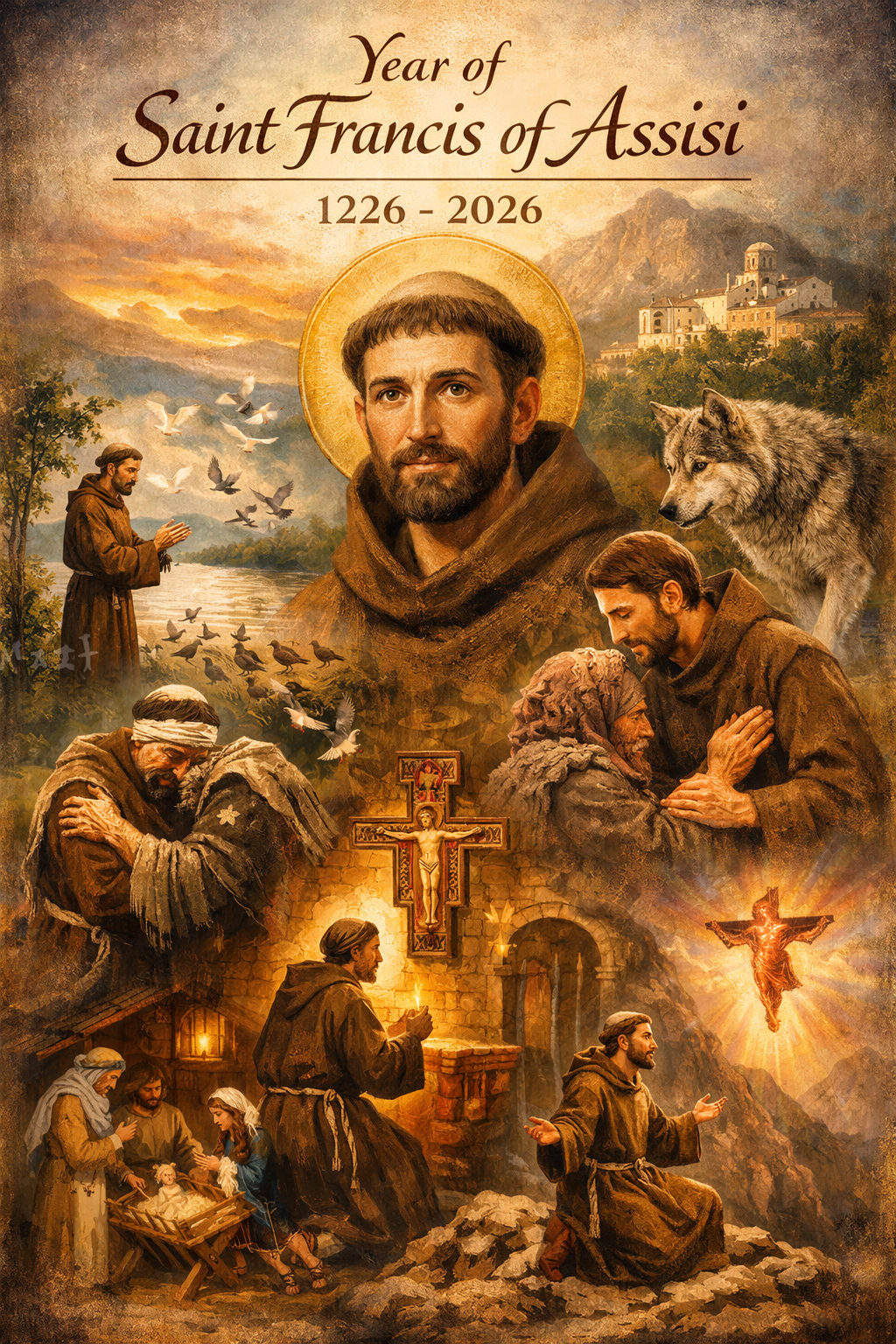
Life, Peace & Justice 2026 EVENTS LIST:
Jan 12, 2026, "World Day of Peace"
Jan 18, 2026, "MLK Day Choir and Dinner"
Feb 3, 2026, "Life, Peace and Justice planning meeting"
Feb 24, 2026, "Christ the immigrant and SNL Circle meeting"
Feb 28, 2026, "Stragers No Longer monthly meeting"
Mar 3, 2026, "Life Peace and Justice planning meeting"
Mar 10, 2026, "From Conversion to Compassion: St. Francis and the way of Peace"
Mar 22, 2026, "Interfaith Day of Unity 2026"
Apr 12, 2026, "SNL Annual Banquet and Basket sale"
Apr 21, 2026, "St. Francis and the Sacredness of Nature"
May 5, 2026, "Christ the immigrant and SNL Circle meeting
June 2026,
July 8, 2026, "250th Anniversary American Journey Immigration Discussion" with Dr. Bill Lopez, UofM; Dr. Ann Lin, UofM; Ms. Rebecca Olszewski, MIRC; & Mr. Kevin Piecuch, SDIRC.
August 18th, 2026, "Civilize It" - Bring Christ's Peace into Election Season - for Depolarizing Ourselves.
September 15th, 2026, "Civilize It" - Bring Christ's Peace into Election Season - for Skills for Disagreeing Better.
October
November
December
Peace Within Series PAST - December 2025 -
Here we are making this entire series available to all who wish to bring peace within and around the world.
Peace Within and Peace in the World – Contemplation and Action Guide was created by Moe Nagpal. It was originally prepared for presentation with Scott Wright, to the St. Francis of Assisi Catholic Parish, Ann Arbor, MI, in December 2025. This material may be used and reproduced for non-commercial group discussion for educational purposes, provided proper attribution is given to the author and parish.
Click Here to upload an example facilitator guide for Peace in the World. We offer this to all others who would like to use it in their parish or educational institution.
Peace Within WAS (meeting each month from June 2025 - January 2026) a book study and action group focused on fostering peace within our selves, families, communities, Church, country, and world. Are you feeling a call for more than just external achievement? Do the challenges of our families, communities, and the world leave you searching for a more profound and sustainable peace?
Join us as we explore movements towards authentic inner peace, and fostering a “Peace Within Me” to become more compassionate, less judgmental, and more effectively able to contribute to...
Peace in our families through deeper understanding and forgiveness,
Peace in our communities by fostering true solidarity and belonging,
Peace in our Church by embracing unity amidst diversity,
Peace in our country by working together to achieve common good,
Peace and the world by working for justice from a place of wisdom and love, not merely reaction.
Peace in our Hearts by seeking to live more deeply from the peace Christ places in our hearts.
We met each month from June 2025 - January 2026.
~~~~~~ ~~~~~~~~~~~~ ~~~~~~~~~~~~ ~~~~~~~~~~~~ ~~~~~~
Suggested Reading and Discussion Questions
~~~~~~ ~~~~~~~~~~~~ ~~~~~~~~~~~~ ~~~~~~~~~~~~ ~~~~~~
Peace Within Me | Justice Within Me
Key Topics
- Inner peace arises when we live in right relationship with God, ourselves, and others. That means confronting our own sin, healing past wounds, and embracing integrity.
- Without justice (self-honesty, repentance, moral alignment), we experience inner conflict.
- A person who lies or harbors resentment cannot experience full peace until they make things right.
Recommended Resources
Interior Freedom by Fr. Jacques Philippe
Podcasts from Scepter Publishers - Listen
here
Discussion Questions
- What disrupts my inner peace most often?
- How does my relationship with God affect my sense of peace?
- Am I honest with myself and living in integrity?
- How do prayer, silence, or the sacraments restore peace in my heart?
- What role does forgiveness—of myself or others—play in healing?
Please also visit our parish online giving home page. Find outreach ministries listed there.
https://giving.parishsoft.com/app/giving/stfrancisannarbor?tab=home
Peace In My Family | Justice In My Family
Key Topics
- A peaceful home requires fair treatment of each member—children heard, elders respected, roles shared with equity.
- Justice in the family means reconciliation, forgiveness, and ensuring no one dominates or is neglected.
- A peaceful household isn’t just quiet—it’s one where each person is valued and seen.
Recommended Resources
Familiaris consortio by St. John Paul II - Read
here
Discussion Questions
- Are there unresolved tensions or hurts in my family that need attention?
- How do we practice love and fairness in everyday family life?
- How can I be a peacemaker without becoming passive or avoiding conflict?
- What spiritual or practical tools can strengthen peace at home?
- Do we make room for prayer, shared meals, or Sabbath time together?
Peace In My Community | Justice In My Community
Key Topics
- Communities flourish when there is fairness—access to housing, education, healthcare, and safety for all.
- Peace is impossible when some are oppressed, ignored, or denied dignity.
- A neighborhood where violence and poverty persist cannot be at peace until those causes are addressed.
Recommended Resources
The Eight Doors of the Kingdom: Meditations on the Beatitudes by Fr. Jacques Philippe
Archbishop Desmond Tutu's writings on Ubuntu and the possibility of hope
Discussion Questions
- How can my community foster a culture of peace?
- Who in my community is marginalized or unseen—and how can I respond?
- Are there local injustices I’m ignoring or accepting as “normal”?
- What would it look like to bring peace to my neighborhood or workplace?
- Do I know my neighbors’ needs and gifts?
Peace In My Church | Justice In My Church
Key Topics
- The Church is called to be both a spiritual sanctuary and a witness to justice.
- This includes addressing inequality within the parish (e.g., welcoming the poor, diverse cultures) and advocating justice beyond its walls.
- A peaceful parish must also be just in leadership, finances, and inclusion.
Recommended Resources
The Eight Doors of the Kingdom: Meditations on the Beatitudes by Fr. Jacques Philippe
Healing From the Ground Up by William T. Cavanaugh
(Optional) Silent Schism by Brother Louis DeThomasis, FSC, and Sister Cynthia Nienhaus, CSA
Discussion Questions
- Are all people truly welcome in our Church community?
- Does our parish reflect the diversity of our city or region?
- Are conflicts in our Church handled with humility and love?
- Do we speak up when we witness injustice or exclusion in the Church?
- How does the Eucharist shape how we live out peace and justice?
Peace In My Country | Justice In My Country
Key Topics
- National peace is not merely the absence of extremism—it requires social justice:
fair laws, equal rights, economic equity. - Unjust systems (racism, corruption, exclusion) breed unrest and division.
- True peace is not merely the absence of tension: it is the presence of justice.
Recommended Resources
The Harvest of Justice is Sown in Peace from the USCCB - Read here
Forming Consciences for Faithful Citizenship from the USCCB - Read here
Discussion Questions
- Do I see the connection between my faith and civic responsibility?
- What injustices in my country conflict with Catholic social teaching?
- Am I informed about laws or policies that affect the vulnerable?
- How do I balance patriotism with Gospel values?
- Can I engage in political or social dialogue with charity and truth?
Peace In the World | Justice In the World
Key Topics
- Global peace requires fair treatment of all nations, cultures, and peoples— sharing resources, respecting sovereignty, and honoring human rights.
- Peace treaties without justice often collapse.
- Sustainable peace in conflict zones comes only when root injustices are addressed.
Recommended Resources
Caritas in veritate by Pope Benedict XVI - Read here
Discussion Questions
- What global issues break my heart—and how can I respond as a Catholic Christian?
- Do I pray for peace in places of war and crisis?
- How are my consumption habits connected to global injustice?
- What can I learn from Catholics or others working for peace globally?
- Do I see every person—regardless of nationality—as made in God’s image?
Peace In Our Heart | Justice In Our Heart
Key Topics
- Everyone is invited to join in prayer, practice and when possible in-person ...come... for the Peace in our Hearts contemplation and action session.
- "Everyone must sincerely co-operate in the effort to banish fear and the anxious expectation of war from our minds." - Pacem in Terris, Saint Pope John XXIII ... And, Pope Leo XIV continues to echo here... We advocate for “integral disarmament,” which can only be achieved through renewal of the heart and mind. Our Peace Within efforts here at St Francis Parish desire to be thoroughgoing and complete, and reach people’s very souls!
- This is a call that Jesus’ disciples are invited to live in a unique and privileged way; yet it also finds its way into every human heart. Peace exists; it wants to dwell within us. It has the gentle power to enlighten and expand our understanding; it resists and overcomes violence. Peace is a breath of the eternal: while to evil we cry out “Enough,” to peace we whisper “Forever.” And we are confident that mutual trust can be achieved, for it is a thing which not only is dictated by common sense, but is in itself most desirable and most fruitful of good.
Recommended Resources
Message on World Peace Day from Pope Leo XIV: https://www.vatican.va/content/leo-xiv/en/messages/peace/documents/20251208-messaggio-pace.html
Discussion Questions
- Am I rooted in God’s presence, trusting Him through prayer, the sacraments, and surrender, or am I allowing fear and self-reliance to govern my interior life?
- What unresolved wounds, resentments, or sins disturb my peace, and am I willing to seek healing through forgiveness, reconciliation, and honest self-examination?
- Is my conscience formed by the truth of the Gospel and the teaching of the Church, or by comfort, ideology, or personal preference?
- Do my daily choices, words, and attitudes reflect charity and humility, or do they quietly sow division, pride, or restlessness within me and around me?
- Where is God inviting me to act—practically and concretely—to deepen peace in my heart so that it may overflow into peace for others?
Over the past months, we have been invited to listen and reflect on the gift of peace—beginning within our own self and extending outward to our families, our Church, our communities, our nation, and our world. Through prayer, Scripture, and shared reflection, many of us have been quietly changed, becoming more aware of how Christ calls us to be peacemakers in both small and meaningful ways. As we gather one more time reflecting on the World Day of Peace message from Pope Leo XIV, we invite you to join us in a spirit of gratitude and openness to share what this journey has stirred within your hearts and how God may be calling us to carry His peace forward together. This will be a sacred space for listening, hope, and discernment, as we seek to live more deeply from the peace Christ places in our hearts.
Consider making a donation in support of the Outreach for more Peace Within @ St. Francis Parish here on our ParishSoft-Giving: Scroll down to look down-under the Outreach option in the list and donate to help those who are "at the bottom" - the lowest-income households, struggling workers, and those most vulnerable to poverty and inequality.
Justice Advocacy Articles
Click here for some of our recent articles which are shared in a Google Doc folder here.
Catholic Social Teaching Major Themes
1. Life and dignity of the human person – All people are holy, made in the image of God.
2. Call to family, community and participation – People are both holy and social; when one suffers, we all suffer.
3. Rights and responsibilities – People have a basic right to life, food, shelter, health care, education and work.
4. Option for the poor and vulnerable – The “Jesus” test of a community (of society) is how it treats its neediest members.
5. Dignity of work and the rights of workers – Money, work and business exist to serve people, not the other way around.
6. Solidarity – We want justice for all people.
7. Care for God’s creation – The environment is God’s sacred creation.